
Why your head gets this full
Minds are built to notice open loops — the unanswered email, the thing you almost said, the decision you have not made — and to keep them warm until they are closed. That was useful when a person had six open loops. Most of us are now running dozens, and the mind treats every single one as worth another pass.
The load is invisible, which is half the problem. Nobody sees a full head. You can spend a whole day managing it and have nothing to show anyone, which is why so many people describe feeling exhausted "for no reason." There is a reason. It just does not photograph well.
None of this means something is wrong with you. A mind that keeps returning to unfinished things is doing its job. The skill is not stopping the mind; it is closing loops on purpose, in daylight, so they stop asking at midnight.
Thinking or worrying? The five-minute test
Real thinking moves. It gathers something new, decides something, ends somewhere different from where it started. Worry loops. It visits the same three stations in a circle — what if, remember when, I should have — and arrives back with nothing.
The test is simple: after five minutes on a subject, ask what is new. If there is a new fact, a next step, or a decision, you were thinking. Keep going if you want. If nothing is new, you were rehearsing, and more laps will not help, because a loop does not run out of fuel — it runs on attention. That is not a character flaw. It is just the signal to switch tools: from thinking about it to writing it down, which is where loops actually go to end.
a new fact, a next step, or a decision
nothing is new
more laps will not help
switch tools: from thinking about it to writing it down
When the thoughts turn on at night
Night is prime time for a full head, and the mechanics are almost mechanical: the room finally goes quiet, so the backlog gets the floor, and since you cannot act on anything at 1 a.m., the mind loops instead. The way out is not discipline; it is storage — a short written routine that empties the loops and formally postpones them until morning. We wrote a full step-by-step guide to exactly this: How to quiet a racing mind at night, including the three-step Night Page you can run tonight on any scrap of paper.
The replay channel: one conversation, forty showings
Replaying a conversation — what they said, what you said, what you should have said — is the mind trying to protect you from a rerun of a bad moment. The problem is it protects you by making you live the moment forty more times.
Two moves shorten the season. First, write the replay down once, fully, in the exact words it uses. A replay on paper loses its urgency, because the mind no longer needs to keep it warm. Second, name what the replay is actually asking. Usually it is one question wearing a costume — "did I damage something?" or "do I need to say something?" If yes, that is a task: one message, one apology, one clarification, scheduled for daylight. If no, the replay has no job, and naming that out loud is surprisingly effective: "There is nothing this is for."
Thoughts are suggestions, not verdicts
The heaviest thoughts are the ones you believe instantly. "I'm behind everyone." "They're annoyed with me." "I always do this." The moment a thought like that lands as a fact, your mood obeys it.
There is a well-tested middle step, borrowed from cognitive behavioural work: treat the thought as a suggestion and check it like you would check anyone else's claim. What is the actual evidence? What would I tell a friend who said this about themselves? What else could be true? You will not win every round, and you do not need to. The goal is smaller and more reachable: a gap between thought arriving and thought being believed. In that gap, you get a say.
your mood obeys it.
- What is the actual evidence?
- What would I tell a friend who said this about themselves?
- What else could be true?
a gap between thought arriving and thought being believed

A place to put it all: journaling without the mystique
Journaling has a reputation problem — it sounds like it requires candles, discipline, and something profound to say. In practice, the version that helps a full head is closer to bookkeeping: short, honest lines about what is taking up space, written most days, badly, in five minutes.
Start with one page and one question: "What is loudest right now?" Write the answer in plain sentences. That is the entire practice. On harder days, add a second question: "What, if anything, is mine to do about it today?" Most of the benefit lives in those two questions, and no blank-page dread is required.
Try this now
the two-line unload
Take any paper.
the loudest thing in your head, in its own words.
"tomorrow" plus a time if it needs action, or "nothing" if it does not.
That is a closed loop.Do it for the next two loudest things and notice the change in the room.
Where a journal earns its place
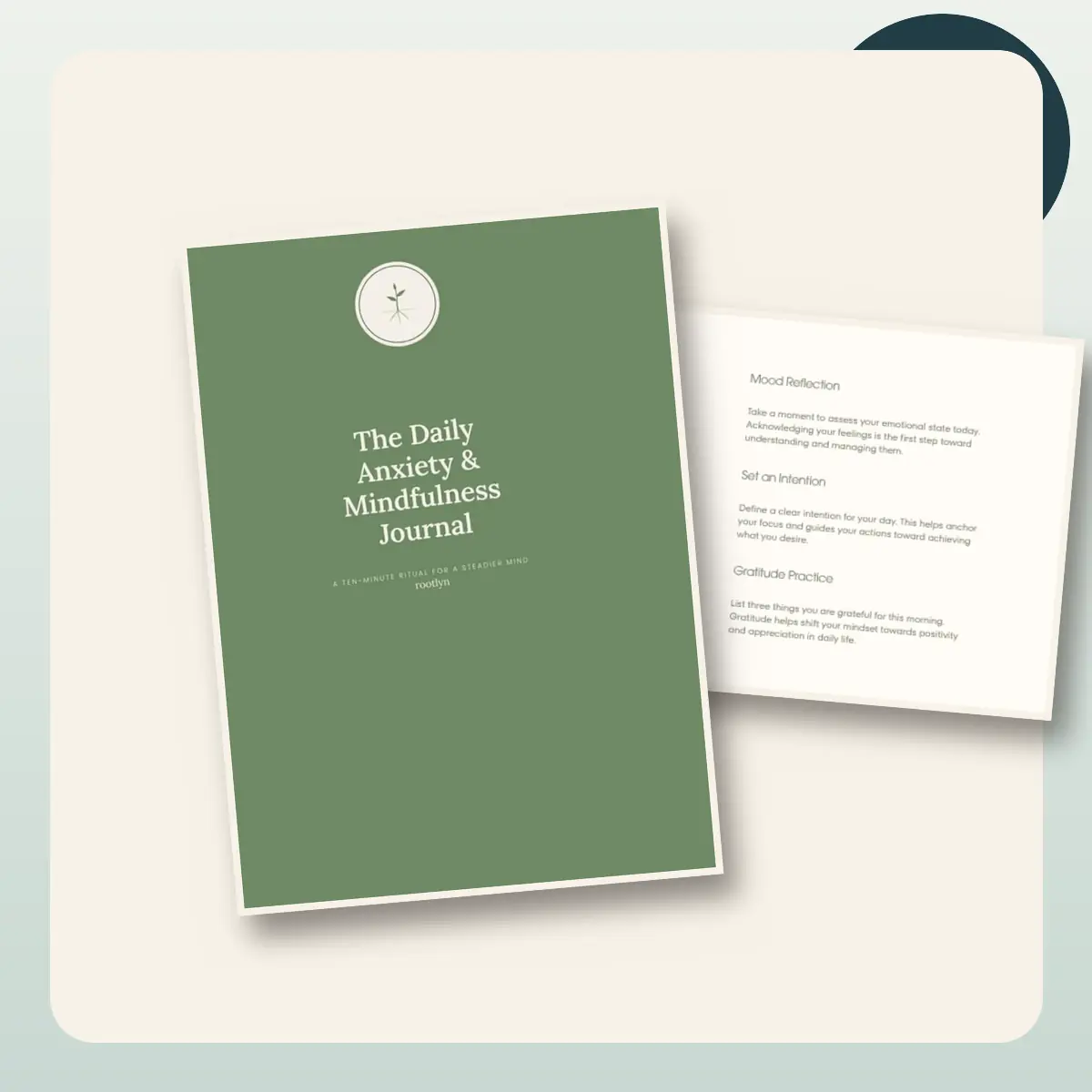
Real questions, short answers
Is overthinking the same as anxiety?
They overlap but are not identical. Overthinking is a habit of the mind; anxiety is a whole-body state that often drives it. If the thinking comes with a racing heart, dread, or avoidance that shapes your days, it is worth reading about anxiety specifically and, if it persists, talking to a professional.
Why is my mind worse at night?
Because night removes the competition. Quiet room, no tasks, full backlog. See the racing-mind guide for the routine that handles it.
Does writing things down really help, or is that a cliché?
It is one of the rare clichés with receipts. Externalising thoughts reduces their repetition because the mind stops guarding them. The trick is writing specifics, not summaries — "reply to Dana about the invoice," not "sort out work stuff."
When is a full head something to see someone about?
When it stops being occasional. If most days feel like this for weeks, if sleep, appetite or mood are sliding, or if the thoughts turn dark, that is a doctor-or-therapist conversation, and having it is a practical step, not a defeat.
Sources
- American Psychological Association, on rumination and stress — www.apa.org
- NHS, "Tips to reduce anxiety and stress" and insomnia self-help — www.nhs.uk
- Beck Institute, foundations of cognitive behavioural techniques (thought examination) — beckinstitute.org
- Sleep Foundation, "Racing Thoughts" — www.sleepfoundation.org
Last reviewed: