
Why money worry rarely matches the maths
Ask people what they stress about most and money reliably tops the list — ahead of work, ahead of health — and it does so across income levels, which is the revealing part. If money stress tracked balances, it would fade as balances grew. It often does not, because the worry is not really about the number. It is about uncertainty, safety, and what money meant in the house you grew up in.
Uncertainty is the main engine. A mind that does not know fills the blank, and a stressed mind fills it pessimistically. The imagined account balance is almost always worse than the real one, and the imagined version is the one you carry to bed. That is why the single most calming move in this whole subject is not earning more or spending less — those take months — it is replacing one imagined number with one real one, which takes about ninety seconds and works today.
The avoidance spiral, named kindly
Nearly everyone with money worry has something unopened. An envelope on the counter. An app deleted "for peace." A statement marked unread. This is not laziness or irresponsibility, and you should retire both words. Avoidance is a completely understandable trade: skip a bad feeling now, accept a vaguer bad feeling later.
The problem is the interest rate. Unopened things compound. Whatever the letter says, your imagination is quoting worse, daily. And every day of not-looking quietly confirms the story that you cannot cope with what is inside, which is almost never true — people cope with real numbers far better than they cope with fog.
If one specific unopened thing came to mind while reading this, that thing is your entire homework from this page. Not the whole backlog. One envelope, opened at a calm hour, with the next step decided in advance ("whatever this says, I will write the amount and the date on the front and put it in the tray"). The relief is usually embarrassing in its size.

Facts in one column, fears in the other
Here is the core exercise this whole room is built around, and it needs one sheet of paper. Left column: "What I know." Right column: "What I'm assuming." Facts on the left — what comes in and when, what is genuinely due this month with dates, what is already covered, and "not sure" wherever that is the truth. Fears on the right, in their own words: "it's all going to come at once," "there won't be enough."
Read the two columns back. The left one is short sentences with dates. The right one is weather. Most of the worry has been living on the right, and several of its biggest items dissolve on contact with a date — the bill that "is about to hit" is three weeks away, the thing that felt uncovered was covered. Whatever survives on the left as a real concern gets an appointment: a day, a time, twenty minutes, login ready. We walk this whole routine step by step in How to stop worrying about money.
- what comes in and when
- what is genuinely due this month with dates
- what is already covered
- "not sure" wherever that is the truth
"it's all going to come at once"
"there won't be enough"
The left one is short sentences with dates. The right one is weather.
The money hour: one appointment instead of constant leakage
Money worry spreads because it has no home. It interrupts dinner, colonises Sunday, taps you on the shoulder during films. The counterintuitive fix is to give money more structure, not less: one hour a week, same day, same time, where money things happen — and outside of which money things wait.
In the hour: open the thing, check one number, answer one letter, date the next task. That is a full hour's work. When a money thought interrupts on Wednesday, you have a true sentence available: "That has an appointment." It sounds too simple. It is also the habit that most reliably returns the other 167 hours of the week to you.
- open the thing
- check one number
- answer one letter
- date the next task
when it interruptsThat has an appointment.
Money and the people you love
Money is the argument most couples have most often, and usually it is not really about the spending — it is two different childhood money-worlds negotiating without knowing it. One person soothes by checking; the other soothes by not looking. One saves to feel safe; the other spends to feel alive. Neither is wrong, and both feel judged.
Two ground rules lower the temperature. Talk about money at a planned, calm time — never at the point of purchase, never at midnight. And start from feelings before figures: "I get anxious when I don't know where we stand" opens a conversation; "you spent what?" opens a courtroom. Boundaries around lending and family requests deserve their own page, and we wrote one: How to set boundaries with family, including the exact words for money requests.
Where a journal earns its place
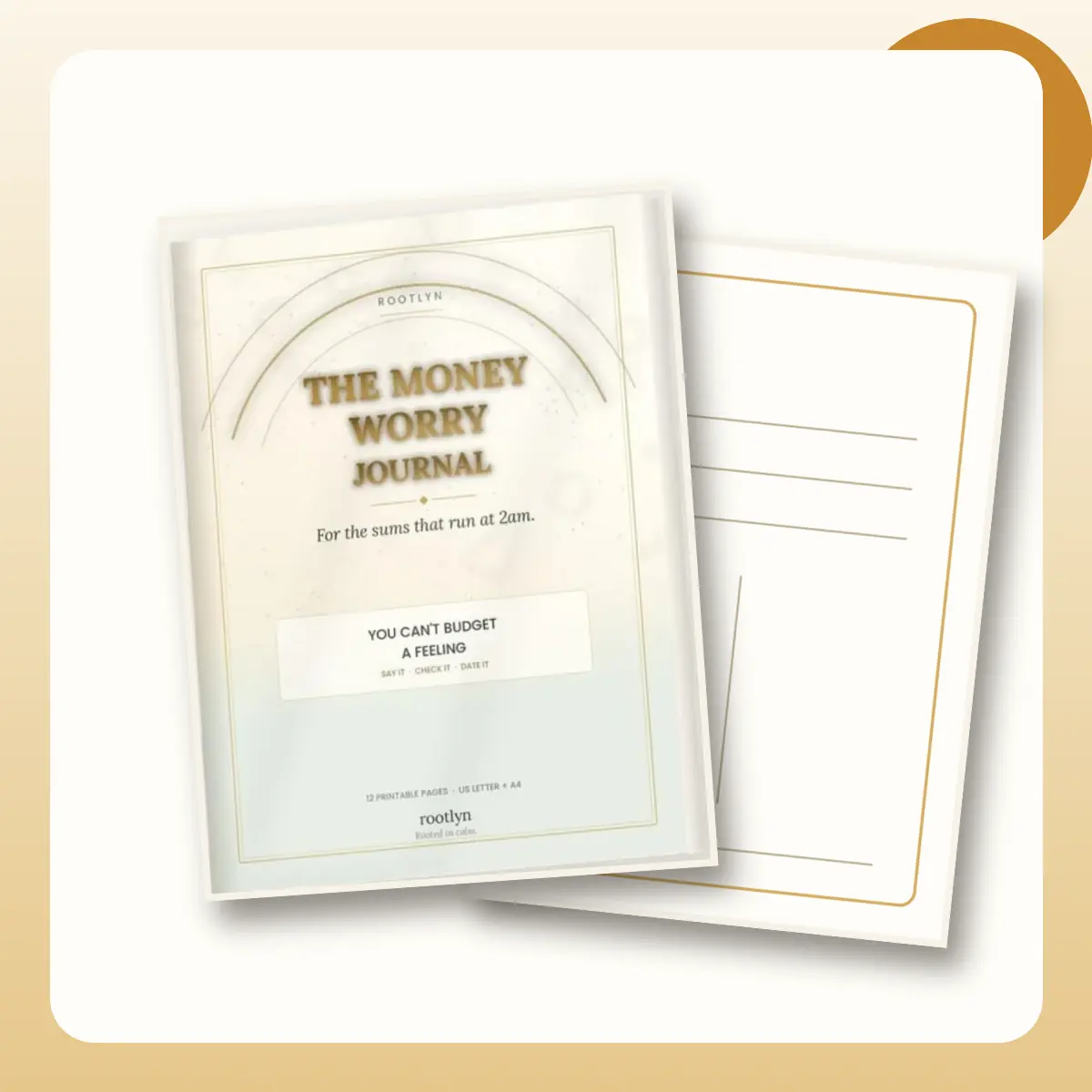
Real questions, short answers
Is financial anxiety a real thing?
Yes — the term simply describes persistent stress and fear around money, and it is extremely common. It responds well to exactly the moves on this page: reducing uncertainty, ending avoidance in small pieces, and separating facts from projections. If it is severe or long-running, a therapist genuinely helps, and so does regulated debt advice where debt is part of the picture.
Why do I feel guilty every time I spend, even small amounts?
Usually an old rule is running — spending equals danger — installed years ago and never reviewed. Noticing the rule is most of the work: "that's the old rule talking" is a surprisingly effective sentence at a card machine.
Does making a budget cure money worry?
It cures the part that was disorganisation. Plenty of people finish a perfectly good budget and still brace, because the worry lived in the assumptions column. Numbers in a budget, feelings on a page — both jobs, two tools.
When should I get real help?
If you are behind on payments or the maths genuinely does not work, free debt-advice services exist in most countries and ordinary people use them every day — going is a practical step, not an admission. And if money dread is costing you sleep, health or relationships, that belongs in a conversation with a professional too.
Sources
- American Psychological Association, "Stress in America" (money as a leading stressor) — www.apa.org
- Consumer Financial Protection Bureau, financial well-being research (control and security, not just income) — www.consumerfinance.gov
- Money and Mental Health Policy Institute — www.moneyandmentalhealth.org
- Mind (UK), "Money and mental health" — www.mind.org.uk
Last reviewed: