
It starts with something small. Forty minutes later you are three years into an imagined future and your chest is tight.
The short answer: a spiral is not thinking, and treating it as thinking is what keeps it going. Real thinking moves — it reaches a conclusion or a next step. A spiral circles the same material with rising feeling and no progress. The way out is not to think harder or find the reassuring answer; it is to interrupt the loop physically, get the content out of your head and onto paper where it stops shapeshifting, and separate what you can act on from what you cannot.
Part of our writing on a quieter head.
This is a practical article about an everyday experience. If worry is dominating your life, a GP is the right next step and there are effective treatments.
How to tell a spiral from actual thinking
The test is movement.
Productive worry produces something: a decision, a list, a phone call to make tomorrow. It has an end, and when you reach it you feel slightly lighter.
A spiral produces nothing except more spiral. You cover the same ground repeatedly, each lap slightly worse than the last, and no lap ends anywhere.
| Problem-solving | Spiral | |
|---|---|---|
| Direction | Moves forward | Circles |
| Ends with | A decision or a next step | More worry |
| Feeling | Slight relief | Rising dread |
| Question asked | “What can I do?” | “What if?” |
| Time | Bounded | Expands to fill the night |
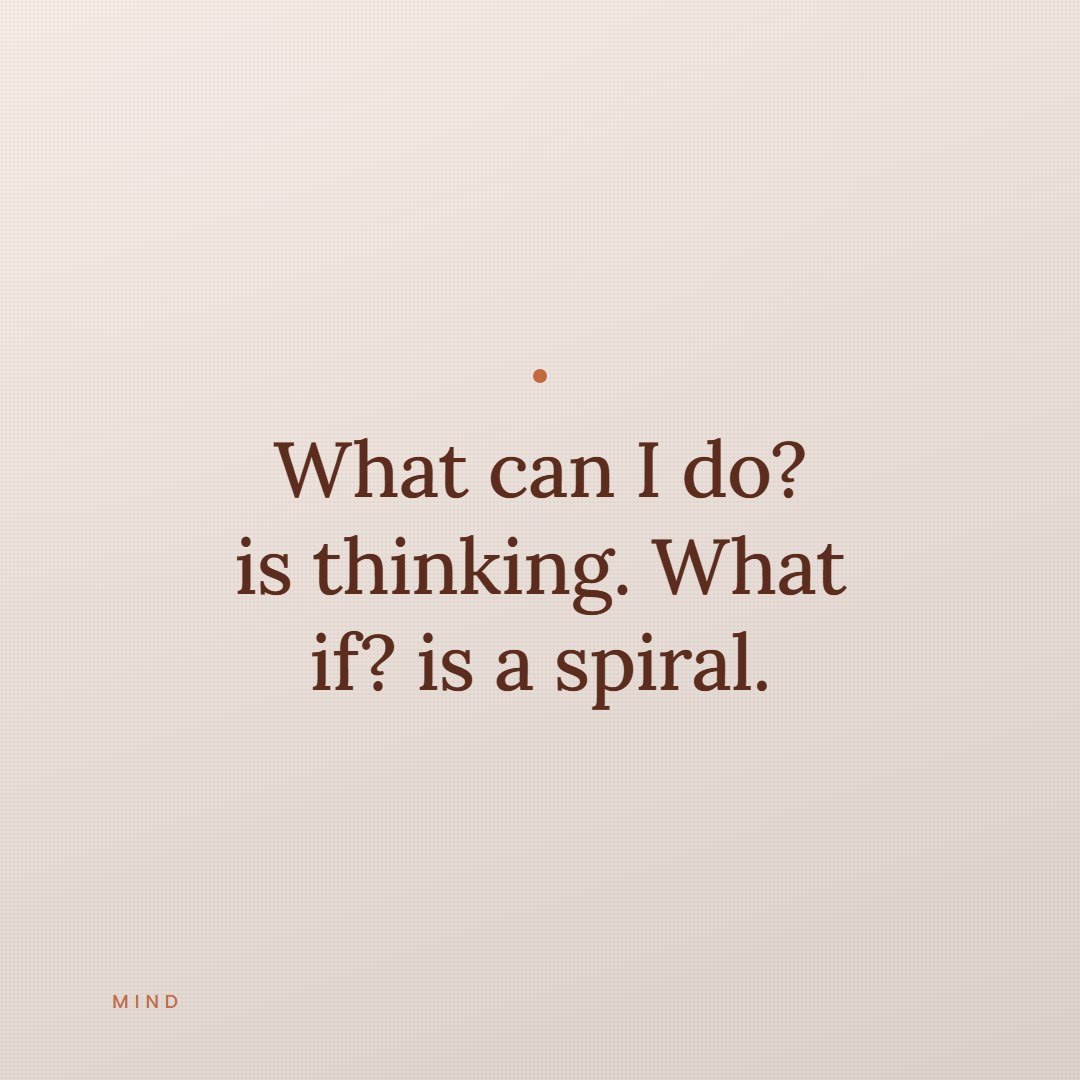
The reliable tell is the question. “What can I do about this?” is thinking. “What if?” is spiralling. If you have asked “what if” more than twice, you are not solving anything, whatever it feels like.
Why it feels productive when it is not
This is the trap, and it is worth understanding because it is what keeps people going round.
Worrying feels like preparation. Some part of you believes that if you can imagine every version of the disaster, you will be ready for it, or you will prevent it by having anticipated it. So stopping feels reckless — like putting down a shield.
It also delivers tiny hits of relief. Every lap contains a moment where you talk yourself down, and that moment is genuinely soothing. Then it starts again. That intermittent relief is exactly the pattern that makes a behaviour hard to drop.
And the spiral rarely stays on topic. It starts with the email and travels to your job, your finances, your competence as a person. That drift is not evidence the situation is that bad. It is what loops do when nothing stops them.
Breaking the loop
You will not reason your way out. The spiral is faster than you and it has an answer for everything. What works is interruption.
Change your body first. Stand up. Go to a different room. Go outside if you can. Cold water on your wrists and face. This is not a distraction technique — physical change alters the state that is generating the spiral, and it works when argument does not.
Slow the breath out. Longer out than in. Four in, six or seven out, for a minute or two. Lengthening the exhale is the most direct lever most people have on their own alertness, and it can be done anywhere without anyone noticing.
Name it out loud. “This is a spiral.” Three words. Saying it changes your relationship to the content from inside the thought to looking at it, and that shift alone often takes some of the force out.
Get it out of your head. A spiral survives on being vague. Written down, worries become specific, and specific worries are smaller — they are also fixed in place instead of shapeshifting into something worse each lap. Write the actual sentence: not “everything is falling apart” but “I think I’ve upset Sarah and she’ll pull out of the project.”
Then sort it into two columns. Things I can do something about. Things I cannot. For column one, write one next action with a time attached. For column two, write nothing — the honest answer is that worrying will not change it, and seeing it in the second column is the point.
Set a worry appointment. Fifteen minutes tomorrow, at a fixed time, to worry deliberately. When the loop starts before then, you tell it: not now, six o’clock. This sounds absurd and it is one of the better-evidenced techniques there is. Most worries never survive to the appointment. The ones that do usually turn out to be real problems that deserved the slot.
Do not go looking for reassurance
This is the one that surprises people.
Checking, googling symptoms, re-reading the message to see if it sounded off, asking your partner again whether it will be fine — all of it works for about four minutes and then makes the next round worse. Reassurance-seeking teaches the loop that it will be fed, so it comes back hungrier.
If you have already asked once and got an answer, you have the answer. Asking a second time is the spiral talking.
The same goes for searching. The internet will always produce a worse version of whatever you type in, and it will always be available at midnight.
The three-in-the-morning version
At night the spiral has advantages it does not have in daylight. You are tired, there is nothing else to occupy you, and your sense of proportion is at its worst.
Do not solve anything at 3am. Whatever you conclude then will look different by breakfast, every single time. That is not optimism, it is how the hour works.
Do not reach for the phone. The light pushes you further awake and the content gives the spiral fresh material.
Have somewhere to put it. A pad by the bed, three or four words, no light needed. Not a plan — a placeholder. “Sarah / project.” You are not solving it; you are telling your brain it will not be lost, which is often what it actually wants.
Get up after about twenty minutes. Low light, something dull, back when sleepy. Our article on why you cannot sleep even though you are exhausted covers the rest of that.
When it is the same worry every time
Some spirals are one-offs. Others are the same theme every night for months, and those respond to something more deliberate than in-the-moment techniques.
The approach with the best evidence behind it is writing the thought down and examining it properly rather than arguing with it in your head — what the thought actually claims, what evidence exists for it, what evidence exists against it, and what a fairer version would be. Done in the moment, that is nearly impossible. Done on paper, at a calm time, it is very doable and it changes the pattern over weeks.
The Thought Record Kit is a printable built for exactly that: a structured page you fill in when a recurring worry has hold, which walks through the thought, the evidence on both sides, and a balanced alternative — the method used in cognitive behavioural therapy, laid out so you can do it yourself without needing to remember the structure.
It is not therapy and does not replace it. It is the practice part, on paper, for the worries that keep coming back.
One honest caution
Everything here is for everyday worry. If worry is most of your day, if you cannot work or sleep or be present with people, if there are panic attacks, or if you feel hopeless, that is not a technique problem — it is something treatable and worth taking to a GP. Anxiety responds very well to treatment, and the average person waits far too long before asking.
If your thoughts turn to harming yourself, please contact your GP or a crisis line now rather than working through this alone.
The short version
Check the question you are asking. “What can I do?” is thinking; “what if?” is a spiral. Interrupt it with your body rather than your reasoning — stand, move, lengthen the out-breath, name it out loud. Write the actual sentence down, because vague worries are the big ones. Split it into what you can act on and what you cannot, and give the first column one next action with a time on it. Book a worry appointment. And do not go looking for reassurance, because it feeds the thing you are trying to end.
You are not going to think your way out of this. You are going to interrupt it, and then write it down.
Frequently asked questions
How do I stop a worry spiral once it has started?
Interrupt physically before you try to reason. Stand up, change rooms, splash cold water, lengthen your out-breath, and say “this is a spiral” out loud. Then write the actual worry down as a specific sentence, because vagueness is what keeps it circling.
What is the difference between worrying and problem-solving?
Problem-solving moves towards a decision or a next step and then ends. A spiral covers the same ground repeatedly with rising dread and no conclusion. The clearest tell is whether you are asking “what can I do?” or “what if?”
Why does worrying feel useful even when it changes nothing?
Because it feels like preparation, and because each lap contains a brief moment of self-reassurance that is genuinely soothing. Intermittent relief is exactly the pattern that makes a habit stick, which is why stopping feels risky rather than freeing.
Does a worry appointment actually work?
For many people, yes. Setting a fixed fifteen minutes to worry deliberately lets you postpone rather than suppress, which is far easier. Most worries do not survive until the appointment, and the ones that do are usually real problems that deserved proper attention.
Why is worry so much worse at night?
You are tired, there is nothing else occupying you, and your sense of proportion is at its lowest. Anything concluded at 3am reliably looks different by morning. Keeping a pad by the bed for three or four words, rather than solving anything, is usually enough.
Should I ask someone for reassurance when I am spiralling?
Once is fine. Repeatedly is counterproductive — reassurance-seeking relieves the feeling briefly and strengthens the loop, so the worry returns sooner and stronger. If you have already had the answer, you have the answer.
Last reviewed:
Read next
If this was useful
Mind
Tracking Your Mood Without It Becoming a Chore
Most mood trackers ask too much and get abandoned by February. Why one square a day beats a page, and what the…
Money
Lending Money to Family Without Ruining It
The money is rarely the damage. Not knowing where you stand is. How to decide before you answer, and how to raise…
Money
How to Stop the Spending You Regret Afterwards
The purchase is doing a job that has nothing to do with the thing you bought. What it is actually for, and…
The Rootlyn letter.
One useful page in your inbox now and then — a real tool, a real moment, no noise. Unsubscribe any time.