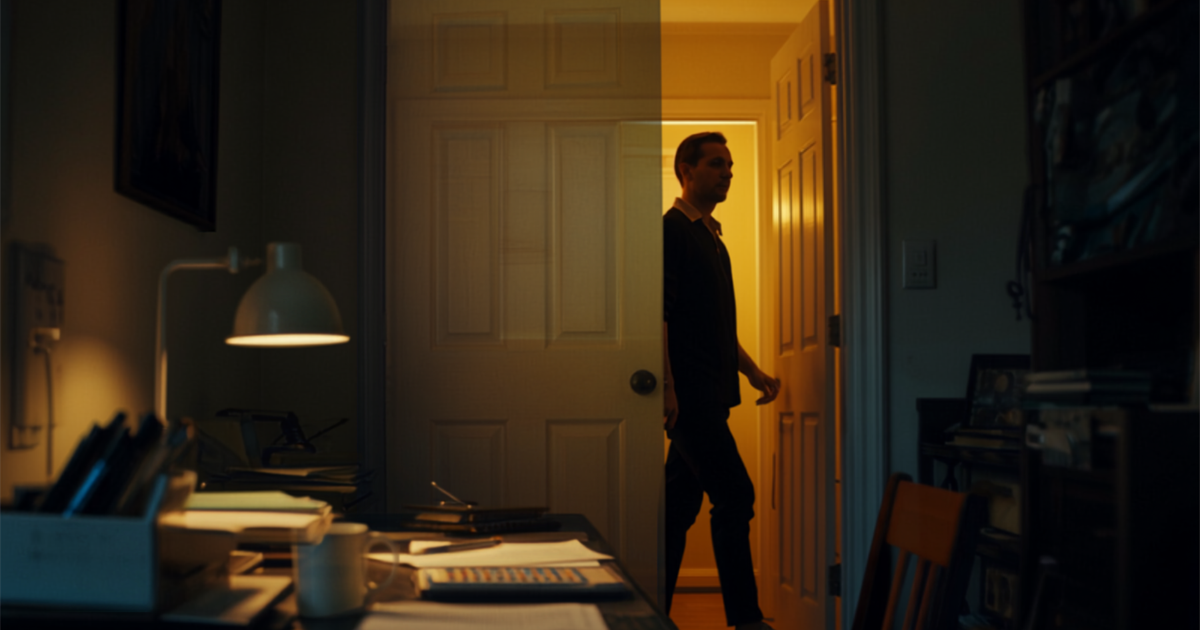
You closed the laptop at six. At half nine you are on the sofa with people you love, mentally rewriting an email.
The short answer: the day did not get an ending, so your mind keeps it open. Work does not follow you home because you care too much or lack discipline — it follows you because unfinished items stay active until they are written down somewhere you trust, and most people go straight from the last task to the front door with nothing closed. A three-minute deliberate ending at the end of the working day does more than an entire evening of trying not to think about it.
Part of our writing on switching off.
Why it follows you
Nothing was closed. Open loops stay open. Twelve unfinished items are twelve small processes still running, and they run in the evening because that is when nothing else is occupying the space.
There was no boundary event. Commuting used to do this — twenty minutes that were neither work nor home, in which the transition happened without effort. Take that away and the last email and the kitchen are separated by nothing at all.
The device came with you. If work is reachable from the sofa, some part of your attention stays on duty, because a system that might need checking is a system being monitored. That monitoring is low-level and constant and it is why you feel tired without having done anything.
You are still braced. If the day involved something difficult, your body is often still in it hours later. That is not a thought problem and thinking harder does not resolve it.
| What is happening | What it feels like | What closes it |
|---|---|---|
| Open loops still running | “I keep remembering things” | Write tomorrow’s list before leaving |
| No transition | “I never arrived home” | A deliberate boundary act |
| Reachable devices | Vaguely on duty all evening | Physical separation from the device |
| Still braced | Tired but wired, no specific thought | Movement, not reasoning |
The three-minute ending
This is the highest-return thing in the article and almost nobody does it.
Before you finish, spend three minutes writing:
- What I did today. Two or three lines. This matters more than it sounds — the feeling of having achieved nothing is a major driver of evening rumination, and it is usually wrong.
- What is not finished, and where it is. The open loops, named. They close when they are recorded somewhere you trust.
- What I do first tomorrow. One item. Not the whole day. This is the one that stops the 11pm remembering, because the remembering is mostly your mind rehearsing so you do not forget.
Three minutes. Then stop.
Doing this on Friday is worth more than any amount of Sunday planning, which our article on why Sunday nights feel worse goes into.
Build an ending, since the commute is gone
You need a boundary event. It does not need to be long, it needs to be consistent and physical.
- A ten-minute walk around the block. The most reliable one, because it reproduces the commute almost exactly.
- Changing clothes. Slightly absurd, unreasonably effective.
- A shower.
- Music while cooking, deliberately chosen.
- If you work from home, closing the door on the room or putting the laptop physically away — in a drawer, in a bag, out of sight.
The mechanism is that your brain uses context to switch modes. Give it a repeated cue and it starts doing this on its own within a fortnight.
The device is most of it
Take work notifications off your personal phone. Not silenced — off. Silenced still gets checked.
Decide the check, if you must check. “Once at eight, for five minutes” is a boundary. “Whenever I glance at it” is being at work all evening at low intensity.
Charge it in another room. The single most effective change most people make, and the one they resist hardest.
Reply tomorrow. Answering an email at ten teaches everyone that you answer emails at ten, and then they arrive at ten. Most professional norms are set by what people do, not by what is agreed.
If your job actually is like that
Some of this needs saying plainly.
If you cannot switch off because the workload is genuinely unfinishable, that is not a wind-down problem and no evening routine fixes it. Better boundaries help you cope with an unreasonable job slightly longer, which is not the same as solving it.
If you are on call, or in a culture where not answering has consequences, then the honest move is to be deliberate about which hours are protected rather than pretending all of them are.
And if you are dreading the day rather than just carrying it, that is different again — worth looking at properly rather than managing indefinitely.
When the evening needs somewhere to put things
If what keeps running is a mind still producing at eleven — the list, the conversation you keep rewriting, the thing you must not forget — that needs somewhere to go that is not your head in the dark.
The Quiet Night Journal is built for that slot: a short structured wind-down done before bed rather than in it, where the day’s leftovers get written down and closed off, so the first quiet moment of your day is not also the first time your brain has been allowed to think.
It is a printable, so nothing glows and there is no screen involved, which matters given that the device is usually half the problem.
If the difficulty is that you are exhausted and still cannot sleep, our article on why you cannot sleep even though you are exhausted is the more direct one.
One honest caution
Not being able to switch off occasionally is ordinary, especially in a hard week.
If it is constant, if you are exhausted regardless of how much you sleep, if you have stopped enjoying things you used to, or if you feel detached from people at home, that is worth taking to a GP. Burnout and low mood both present exactly like this, and both are treatable — and both get blamed on poor discipline for months first.
The short version
The day follows you home because it never ended. Give it one: three minutes before you finish, writing what you did, what is open and where it lives, and the one thing you do first tomorrow. Then build a physical boundary — a walk, a change of clothes, the laptop out of sight — and put the work notifications off your personal phone rather than on silent. Reply tomorrow.
You are not bad at relaxing. Nobody ever told the day it was over.
Frequently asked questions
Why can’t I stop thinking about work in the evening?
Because unfinished items stay active until they are recorded somewhere you trust, and most people finish the day without closing anything. The evening is simply when nothing else is occupying the space they are running in.
What is the quickest way to switch off after work?
Three minutes before you finish: what you did, what is unfinished and where it is, and the one thing you do first tomorrow. Then a physical boundary act — a short walk, changing clothes, putting the laptop out of sight.
Should I check work emails at night?
If you must, decide a single fixed check with a time limit rather than glancing whenever. Answering at ten teaches everyone that you answer at ten, and the messages start arriving accordingly.
Does working from home make this harder?
Usually, because the commute was doing the transition for free. Recreating it deliberately — a ten-minute walk at the same time each day — restores most of what was lost, and closing the door on the room matters more than people expect.
Why am I exhausted in the evening when I have not done anything physical?
Partly the low-level monitoring of a reachable work system, which is constant and tiring, and partly still being braced from something difficult in the day. Movement helps that second one considerably more than reasoning does.
When is this more than a wind-down problem?
If it is constant, if sleep does not restore you, or if you have stopped enjoying things, that is worth taking to a GP rather than solving with a routine. Burnout looks exactly like this and gets blamed on discipline for months first.
Last reviewed:
Read next
If this was useful
Mind
Tracking Your Mood Without It Becoming a Chore
Most mood trackers ask too much and get abandoned by February. Why one square a day beats a page, and what the…
Money
Lending Money to Family Without Ruining It
The money is rarely the damage. Not knowing where you stand is. How to decide before you answer, and how to raise…
Money
How to Stop the Spending You Regret Afterwards
The purchase is doing a job that has nothing to do with the thing you bought. What it is actually for, and…
The Rootlyn letter.
One useful page in your inbox now and then — a real tool, a real moment, no noise. Unsubscribe any time.