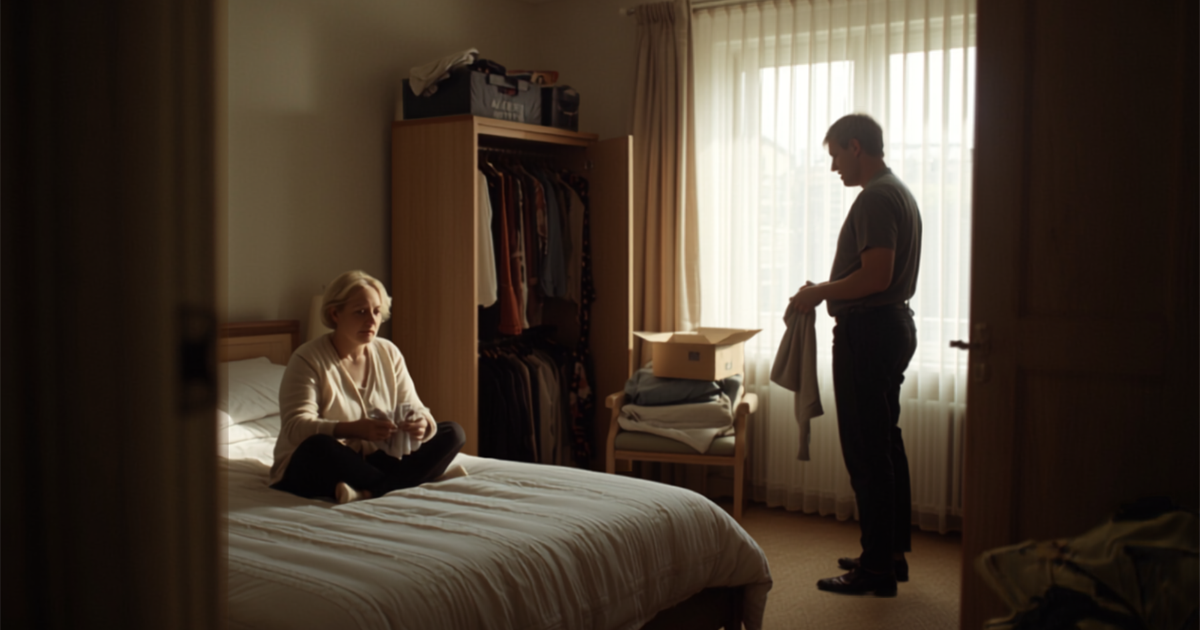
Their coat is still on the hook. You have walked past it two hundred times and you are not ready, and someone has started asking what you are going to do about the house.
The short answer: you do not have to decide about an object in order to move it. Add a fourth option — not today — alongside keep, pass on and let go, and the entire job becomes possible. Most people stall because they believe every item requires a final verdict, so they take the whole weight of the loss with each jumper. Sort in short bounded sessions, start with the easiest room rather than theirs, and let “not today” be a real answer as often as you need it.
Part of our writing on what comes after a loss.
If you are recently bereaved and someone is pressuring you about timing, the honest answer is that there is no deadline unless a tenancy or a sale creates one.
Why this is so much harder than clearing a room
Because you are not sorting objects. You are being asked, repeatedly, to decide how much of a person you are allowed to keep.
Every item carries a question that has nothing to do with the item. Their reading glasses are not glasses. The half-used bottle of shampoo is not shampoo — it is the ordinary fact that they expected to use it again.
And the small meaningless things are almost always harder than the important ones. People brace themselves for the wedding photographs and are undone by a shopping list in their handwriting. That is completely normal. The unremarkable objects are the ones that were closest to the actual daily person.
Bereavement organisations are consistent that there is no correct timescale for this and no correct amount to keep. Some people need to clear a room within a fortnight to be able to sleep. Others need a year before they can open a wardrobe. Both are ordinary.
The two pressures, and how to answer them
Other people’s timing. Someone will tell you it is time, or that keeping it is unhealthy, or that they read it should be done within six months. They usually mean well and they are usually uncomfortable watching you grieve. You can say: “I’ll get to it. I’m not doing it yet.” You do not owe a plan.
The exception is real: a rented property, a sale, a care home room, or shared ownership with a deadline. If that is your situation, you are not choosing the timing and the method below is built for exactly that.
Your own timing. Sometimes the person pushing is you — a feeling that you should be further along, that the untouched room is evidence of something wrong. It is not. But it is worth noticing whether the room is a comfort or a place you cannot go, because those are different, and only one of them is worth changing.
The rule that makes it possible
You never have to decide about something. You are allowed to say not today.
That is the whole method. Not today is not procrastination and it is not failure. It is a real answer, and giving it a name and a place is what stops the whole job from stalling.
Without it, every object demands a verdict, every verdict costs you something, and after twenty minutes you are sitting on the floor holding one shoe. With it, you can move through an entire wardrobe, because the hard items have somewhere to go that is not the bin and not your decision.
The four decisions
| Decision | What it means | Where it goes |
|---|---|---|
| Keep | You want this. No justification needed, including for things that make no sense | With your things, not in storage limbo |
| Not today | You cannot decide, and you are not going to today | A named box, closed, dated, kept |
| Pass on | Someone else should have this — family, a friend, a charity | Out of the house within a fortnight if you can |
| Let go | Worn out, broken, or genuinely nothing to you | Recycling or bin, straight away |
The “not today” box is the mechanism. Date it, close it, put it somewhere out of daily sight, and open it again whenever you like — in three months, in three years, never. Many people find that when they do reopen it, half of it has quietly become easy, because the decision was never really about the object. It was about how recently they died.
How to run a session
Short and bounded. Forty-five minutes, timer on. Not “the bedroom today”. Grief is physically tiring and this work is heavier than it looks; two good short sessions beat one collapse.
Start with the easiest room, not theirs. The kitchen. The bathroom cupboard. The utility room. Neutral territory builds the habit and shows you the method works before you reach anything that costs you.
Do not do it alone the first time, and do not let anyone take over. The right person sits with you, holds a bin bag, makes tea, and does not have opinions about the jumper. Say that out loud before they arrive, because well-meaning relatives who start briskly sorting cause enormous damage without meaning to.
Photograph before letting go. A photo of the chair, the coat, the mug. It sounds like a poor substitute and it is unexpectedly effective — a lot of the grip an object has is about not wanting the memory to vanish, and a picture answers that without the wardrobe.
Keep the small odd things. Their handwriting on anything. The receipt in the coat pocket. These are usually worth more later than the formal keepsakes, and they take up almost no room.
Stop when the timer goes, even if you are fine. Especially if you are fine. Grief arrives late; the crash usually comes two hours after the session, not during it.
When other people are involved
If there are siblings or a partner and children, the objects will produce arguments that are not really about objects.
Nobody takes anything before you all agree how it will work. Most family ruptures over belongings start with one person quietly taking something they felt entitled to.
Take turns rather than debating. Go round choosing one item each. It sounds childish and it prevents the discussion where two people explain why they deserve the ring, which nobody ever wins.
Say what you actually want early. Resentment about belongings usually comes from someone who never said, assumed it was obvious, and watched it go elsewhere.
Photographs get digitised, not divided. One person scans, everybody gets copies. This removes what is otherwise the single most painful negotiation.
Money items need proper advice. Anything of real value belongs in the estate and should go through whoever is handling probate, not be decided over a kitchen table.
If the house has to be cleared quickly
Sometimes there is no time, and that is its own grief.
Take a box of the things you know matter — photographs, their handwriting, jewellery, anything with a name attached — and remove it from the house first, before anyone starts. That box is yours and it is not up for discussion.
Then let the rest be practical. House clearance companies do this daily and without judgement. You are not required to hold every item to be a good son or daughter; you did not choose the deadline, and doing it quickly is not doing it carelessly.
Take photographs of the rooms before they are emptied. People rarely regret having them.
When you want a method to follow
Some people want a structure rather than instructions, especially when concentration is the thing grief has taken.
That is what The Not-Today Box is. It is a printable kit built on this method: bounded sessions you can actually finish, the four decisions, and the not-today box as a real named part of the process rather than a failure. It does not tell you how long to grieve, does not promise closure, and does not set you deadlines. It is a set of pages to lean on when you cannot hold the shape of the job yourself.
It is also used by people separating or downsizing, where the objects carry a different weight but the stalling is identical.
One honest caution
There is no evidence that keeping a room untouched is harmful, and none that clearing it quickly means you loved them less. Do not let anyone tell you your grief is being done wrong.
If it has been a long time and you cannot function — if you cannot enter parts of your home, or the belongings have taken over life in a way that frightens you — that is worth talking to your GP or a bereavement service about. Cruse in the UK and Sue Ryder both offer free support, including for grief that arrives years later, which is far more common than people expect.
The short version
You do not have to decide. Add “not today” as a real option with a real box, and the job stops being a series of verdicts. Work in short sessions with a timer, start with the easiest room, bring someone who will hold a bag and not have opinions, and photograph what you are letting go of. Keep the small odd things. Let the timer end it.
Their coat can stay on the hook for as long as you need. Nobody gets to give you a date.
Frequently asked questions
How long should you wait before clearing out a deceased person’s belongings?
There is no correct timescale. Some people need to do it within weeks and others need a year or more, and both are ordinary. The only real deadlines are practical ones — a tenancy ending, a sale, a care home room — and those are not a judgement on your grief.
What do I do with things I cannot decide about?
Put them in a named, dated box and close it. “Not today” is a real answer, and giving it a proper place is what stops the whole job stalling. You can open the box in three months or never, and much of it usually becomes easier with time.
Is it wrong to keep all of a loved one’s things?
No, and there is no correct amount to keep. It is worth noticing whether the belongings are a comfort or something that has taken over your home in a way that distresses you, because those are different situations and only one of them is worth changing.
How do we divide belongings between family without falling out?
Agree the process before anyone takes anything, take turns choosing one item at a time rather than debating who deserves what, digitise photographs so everyone gets copies, and route anything of real financial value through whoever is handling the estate.
What is the easiest way to start?
Start somewhere neutral — the kitchen or bathroom cupboard, not their bedroom — with a timer set for forty-five minutes and someone with you who will hold a bag and not offer opinions. Stop when the timer goes, even if you feel fine.
Does taking photographs of things before letting them go actually help?
Many people find it does. A good deal of an object’s hold is the fear that the memory will disappear with it, and a photograph answers that directly without requiring you to keep the wardrobe.
Last reviewed:
Read next
If this was useful
Mind
Tracking Your Mood Without It Becoming a Chore
Most mood trackers ask too much and get abandoned by February. Why one square a day beats a page, and what the…
Money
Lending Money to Family Without Ruining It
The money is rarely the damage. Not knowing where you stand is. How to decide before you answer, and how to raise…
Money
How to Stop the Spending You Regret Afterwards
The purchase is doing a job that has nothing to do with the thing you bought. What it is actually for, and…
The Rootlyn letter.
One useful page in your inbox now and then — a real tool, a real moment, no noise. Unsubscribe any time.