
When someone kindly offers to handle messages during a medical crisis, agreeing on the exact scope of a family spokesperson during illness helps protect your rest. A trusted point person can relay approved updates without taking on an open-ended role or fielding invasive medical questions alone. Deciding the specific recipients, agreeing the exact wording, setting limits on follow-ups, and establishing what to say when there is no news keeps everyone informed without draining your physical strength.
Choosing the right communication approach depends on your energy levels and how widely you wish to distribute details about your condition. For practical guidance during sensitive periods, explore Rootlyn’s support for important family conversations. For a structured way to prepare what each group may hear, explore the Update Circle Builder on Etsy.
Defining the Spokesperson Role Before Handing It Over
Asking a friend or relative to keep people updated sounds straightforward, yet a general request often leaves the helper uncertain about what they may share. Without clear instructions, helpers frequently struggle to decide who belongs on the distribution list, whether they should answer personal enquiries, and how to handle days without test results. Giving your point person an exact brief removes that guesswork so they can represent your wishes faithfully.
This informal arrangement focuses purely on day-to-day messaging and practical coordination. As explained in guidance from the NHS on accessing health services for someone else, sharing informal news does not grant legal proxy access to clinical records, surgery portals, or medical decision-making. If formal administrative help is required for booking appointments or managing repeat prescriptions, you will need to arrange formal third-party access directly with the GP practice.
Acting as an informal family spokesperson takes noticeable emotional energy, especially when relatives express anxiety or press for additional news. Before passing over your messaging notes, talk openly with your chosen helper to verify they feel comfortable managing incoming replies. When you are feeling depleted, asking for one specific kind of help with clearly bounded responsibilities makes it much easier for your friend to support you without feeling overwhelmed.
An informal messaging role carries no legal authority. It does not allow your helper to speak with medical teams or view clinical notes unless official proxy documentation is registered with your healthcare providers.

Reviewing an update brief together gives your point person confidence about what they can say.
Choosing Approved Wording and Recipients Separately
Keeping family informed during illness does not mean every relative needs to hear the same level of medical detail. You can decide what is appropriate for immediate family while choosing a much briefer summary for colleagues, neighbours, or distant acquaintances. Splitting your audience into separate groups allows you to share health updates with family without having to repeat your story across dozen separate chats.
There is no obligation to provide an inner circle with comprehensive clinical logs simply because they are related to you. As noted in advice from Macmillan Cancer Support on telling people about an illness, patients have complete autonomy over what they disclose, and asking a trusted ally to relay only approved sentences can spare significant fatigue. If you are coordinating news on behalf of another adult, their personal consent and approved phrasing must remain the absolute priority rather than family curiosity.
When drafting your messages, distinguish clearly between facts you want passed along, statements you have rewritten for clarity, and details you prefer to keep entirely private. You can read more about keeping family updated without repeating yourself to balance steady contact with personal privacy. A disciplined spokesperson sticks strictly to what you have written, avoiding personal speculation, medical theories, or unvetted reassurance.
- Phrasing written or directly confirmed by the patient.
- Specific logistical requests such as quiet hours or meal preferences.
- Agreed holding statements when clinical investigations are ongoing.
Approved Information
- Speculation regarding future treatment plans or recovery timelines.
- Private diagnostic details withheld from general discussion.
- Unapproved answers to spontaneous questions from relatives.
Restricted Details
A Worked Example: Nadia’s Update Brief
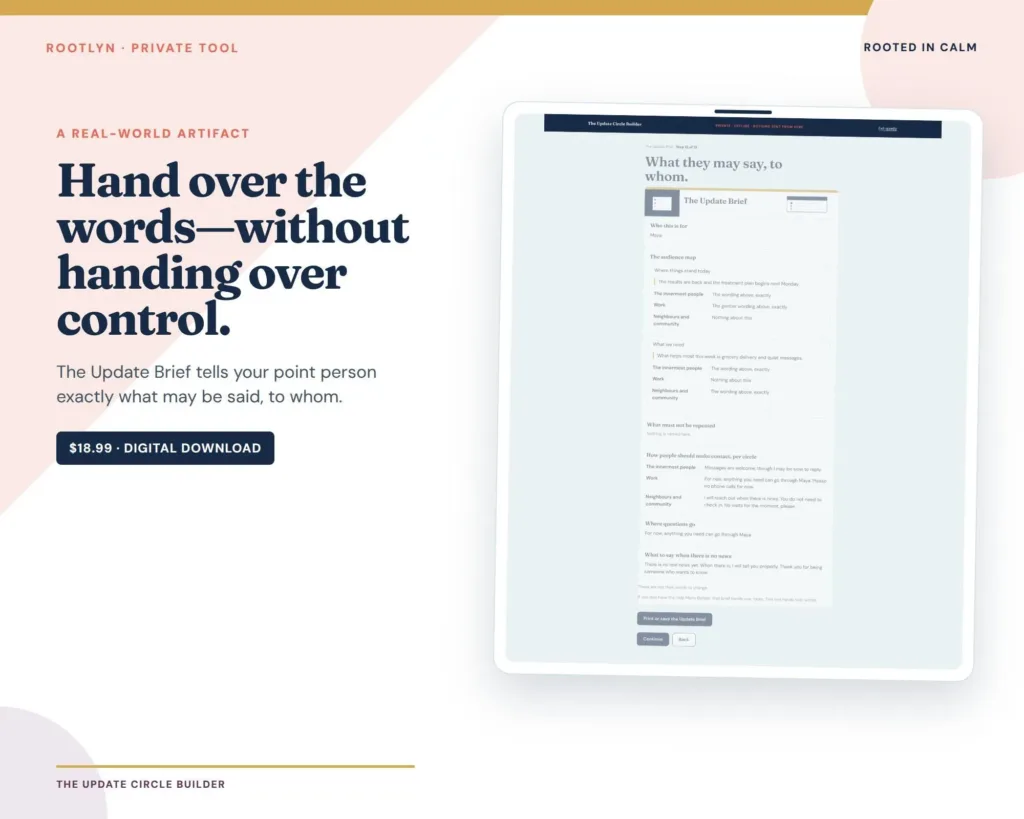
To see how these boundaries operate in real life, review this illustrative brief created for a fictional scenario. It demonstrates how a patient can authorise a friend to relay a single status update while establishing firm parameters around follow-up conversations. This is not a real customer record or an automated software output, but a concrete model showing how clear boundaries protect your daily schedule.
A worked example: Nadia’s update brief
Fictional example: Nadia wants her friend Ben to pass on one approved update while she takes a break from answering messages.
- Who may receive it
- The relatives Nadia has named. Ben checks with her before adding anyone else.
- The approved wording
- “I’m taking some time to rest and won’t be answering calls this week. I’ll share more when I’m ready.”
- If someone asks for more detail
- “Nadia hasn’t asked me to share anything further.”
- When there is no news
- “There isn’t another update to pass on today.”
- Before changing anything
- Ben checks with Nadia before changing the wording, sharing new information or widening the audience.
Notice that Nadia’s brief names the exact group of recipients rather than offering blanket permission to forward the text to extended networks. If you find yourself fielding persistent calls from well-meaning relatives, setting a clear boundary with family creates the breathing room needed to recover. Ben knows precisely what words to send and has explicit instructions to check back before altering a single sentence.
Equally important is the pre-approved holding line for curious replies. Relatives often reply with questions about test schedules, hospital stays, or emotional wellbeing. Providing your helper with a standard response prevents them from feeling pressured to reveal sensitive details or invent reassuring commentary on the spot.
- Clear recipient boundaries stop messages from leaking into unintended social groups.
- Scripted holding lines remove the burden of improvising answers under emotional pressure.
- Explicit check-in conditions confirm that permission applies only to the agreed text.
Organising Your Update Brief with the Circle Builder
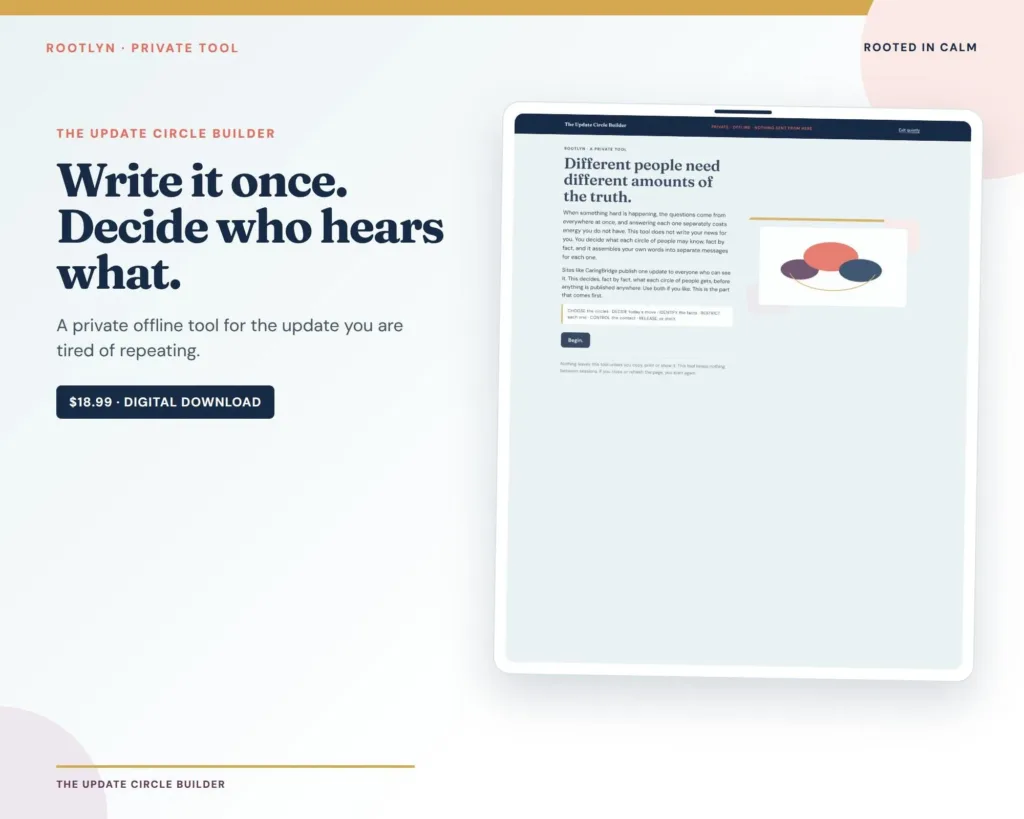
Putting together an update brief can feel taxing when fatigue is high. Rootlyn’s Update Circle Builder provides a structured, quiet environment where you can organise your thoughts away from messaging notifications. You type what is true in your own phrasing, then allocate each statement to the appropriate recipient circle according to your preferences.
The system does not interpret your medical situation, recommend disclosures, or generate artificial text. If you want a softer version for younger relatives or an abbreviated note for neighbours, you write those lines yourself. Once you have sorted your notes, the tool compiles your Update Brief alongside your instructions for your helper, bringing approved statements, contact preferences, and holding wording into one printable layout.
Privacy is central to how the tool operates. It runs entirely locally within your web browser after download, requiring no account creation, login credentials, or cloud data transfers. Because the software does not store session history between visits, refreshing or closing your browser window resets the screen, making it essential to copy or print your finished brief before finishing.
The Update Circle Builder operates locally on your machine without storing data in the cloud. Remember to copy your compiled text or print your physical sheets before closing your browser session.
Handling Unexpected Questions and Days Without News
Even with careful preparation, relatives will occasionally ask questions that go beyond the approved text. When this happens, a spokesperson can easily feel caught between wanting to comfort a worried relative and respecting the patient’s boundaries. Preparing two standard responses in advance equips your helper to navigate these moments calmly.
The first common hurdle is the unscripted enquiry regarding treatment schedules or clinical test outcomes. A disciplined helper acknowledges the enquiry warmly without attempting to guess the answer or promising that information will be provided later. Stating that no further details have been authorised protects personal privacy while keeping the interaction polite.
The second common situation is a quiet day when tests are pending or the household is simply resting. Anxious relatives may assume that silence indicates a sudden crisis, leading to a flood of check-in texts. Using a brief holding line reassures family that the situation remains steady without requiring the patient to supply fresh updates.
The Unexpected Enquiry
When asked for more detail, the helper can say: “Thank you for asking after them. They haven’t asked me to share anything further right now, but I will pass along your love.”
The Day Without News
When there are no developments, the helper can share: “No new updates to report today. Things are steady and quiet, and we will get in touch when there is news to pass on.”
Updating the Brief and Preserving Everyday Connection
Medical situations rarely stay static, and an update brief must adapt as circumstances develop. Giving permission for a friend to distribute one message does not grant open-ended authority for future stages of care. Whenever treatment schedules change or your capacity shifts, review your brief and establish fresh wording before any new announcement is made.
In their resources on talking about an illness, Marie Curie highlights that appointing a spokesperson helps avoid exhausting repetitive conversations, but emphasises checking that the helper remains comfortable over time. Checking in periodically ensures the task has not become emotionally burdensome for your helper. Establishing that the role can be paused or transferred whenever necessary maintains a healthy friendship.
Delegating health bulletins also creates room for normal, comforting companionship. When your spokesperson handles incoming logistical enquiries, you can enjoy quiet moments with friends without every visit turning into a clinical briefing. Loved ones who reach out often simply want to offer comfort, and keeping practical updates separate allows personal conversations to remain relaxed and restorative.
Update permissions do not roll over indefinitely. Confirm fresh text whenever circumstances change, and make sure your helper knows they can step back if managing replies becomes tiring.

Keeping your printed brief in a dedicated folder keeps instructions handy for your helper.
Frequently Asked Questions
Can someone update relatives without receiving every private detail?
Yes, a spokesperson only needs the exact sentences you wish to communicate to others. They do not require access to your full diagnosis, medical notes, or private conversations with doctors to pass on practical news.
Can my point person change the wording?
Your point person should only use the wording you have agreed upon together. If they feel an adjustment is necessary, they should check back with you before sending an altered message to relatives.
What should they say when there is no news?
They can use a neutral holding phrase such as, “There is no new update to share today, and things remain quiet.” This acknowledges the recipient’s message without inventing reassurance or forcing you to write something new.
Does the tool send updates or save my session?
The Update Circle Builder does not transmit messages, connect to phone apps, or store your text after you close the browser. You must copy your finished update or print your physical sheets before exiting the session.
Can I use it offline and print in A4?
The tool runs entirely offline within your local web browser once downloaded. The package includes printable files formatted for both standard UK A4 paper and US Letter sizes.
Practical Next Steps for Your Family Updates
Appointing a trusted person to share approved bulletins protects your physical energy and gives worried relatives reliable information. Taking time to outline exact recipients, pre-approved sentences, and holding lines prevents confusion while respecting your boundaries. To prepare your own words, audience choices and handover instructions, get the Update Circle Builder on Etsy.
Last reviewed: