
When siblings disagree about elderly parent care, one brother might hear on a Sunday phone call that Mum is managing fine, while a sister who called round on Tuesday remembers helping her off the floor after a misstep. When family members see different realities, start by separating what each sibling has directly observed from what they assume it means, then identify one question to explore with your parent rather than deciding an outcome for them. Finding thoughtful support for difficult family conversations helps keep the focus on what your parent actually wants rather than who wins an argument between brothers and sisters.
What decides the right approach is recognising that each person holds only a partial picture of everyday life. Approaching the situation as an enquiry rather than an emergency conference keeps your parent at the centre of their own life and stops practical discussions turning into family friction.
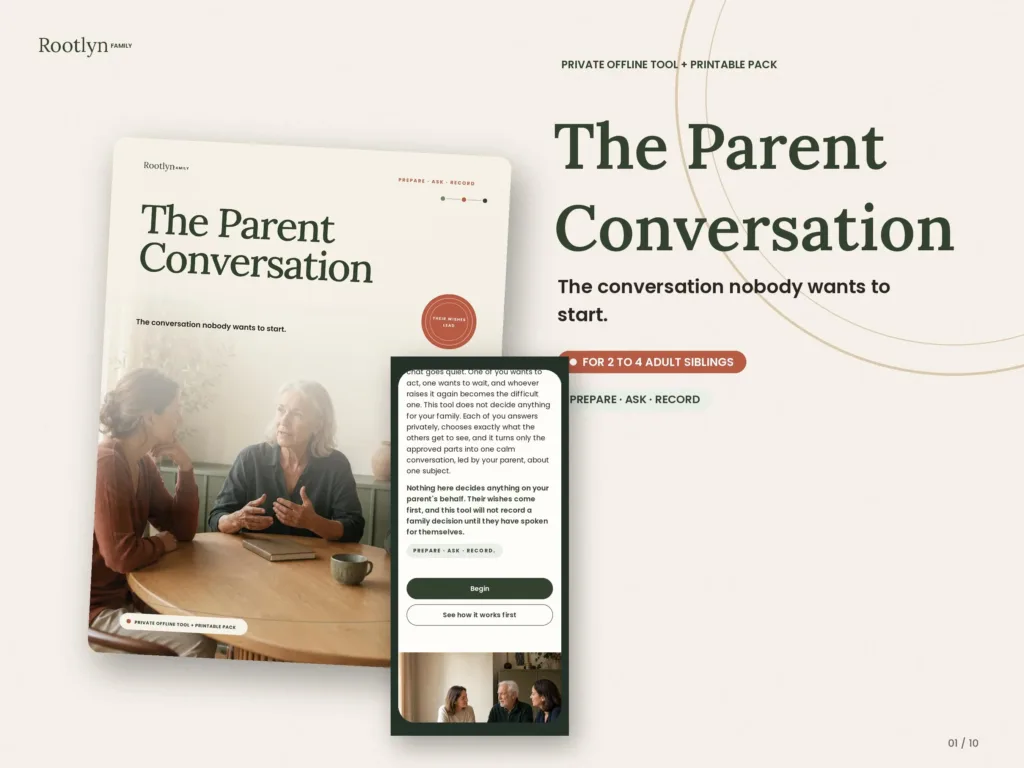
If you want a structured way to prepare separately and bring your approved answers together, explore The Parent Conversation on Etsy.
Why Different Accounts Can Both Contain Something True
Disagreements between adult children rarely happen because someone is deliberately uncaring or unreasonable. Instead, different family members witness entirely different parts of an ageing parent’s routine depending on when and how they interact.
A sibling who pops in on weekday mornings sees the physical effort of opening jars, navigating the stairs, or managing post. Another sibling who rings on Sunday afternoons hears a relaxed, cheerful parent who has rested all morning and genuinely feels in good spirits. A third sibling living further away might carry private anxiety about being asked to leave work or take on responsibilities they cannot balance with their own family.
None of these perspectives is fundamentally false. The brother hearing good spirits on the phone is experiencing genuine warmth, while the sister seeing unopened letters is observing genuine domestic friction. Problems arise when an observation is treated as the entire truth, or when disagreement about an observation is confused with disagreement about what should happen next.
Weekday Visits
In-person visits reveal physical surroundings, forgotten chores, mobility changes, and the practical effort needed to get through normal household routines.
Weekend Calls
Regular phone catch-ups capture mood, social engagement, and emotional wellbeing, often during quiet moments when energy levels are at their highest.
Distant Worry
Brothers and sisters living further afield often view changes through the filter of personal capacity, wondering how future requests might affect their existing work and family commitments.
Guidance from Carers UK on managing family relationships highlights that open, two-way communication prevents resentment from building when roles shift. Acknowledging that every brother or sister has a different vantage point prevents automatic accusations and creates room for honest dialogue.
Turn a Conclusion Back into a Question
When family disagreements about parent care flare up, it is usually because someone has jumped from a concrete observation straight to a sweeping conclusion. Turning those conclusions back into genuine questions prevents misunderstandings before anyone speaks to your parent.
Consider a fictional example involving two siblings, David and Sarah, and their mother, Margaret. David lives ten minutes away and noticed that his mum asked him for lifts to the supermarket twice in one fortnight. He concluded that Margaret could no longer manage food shopping independently and told Sarah they needed to arrange an online delivery service or take over her weekly errands.
Sarah, who speaks to Margaret weekly, felt David was overreacting and taking away their mother’s independence. Neither sibling had paused to separate what was seen from what was being assumed. When they eventually asked Margaret about the supermarket visits, she explained that the local roadworks made the pedestrian crossing awkward on wet mornings, but she thoroughly enjoyed choosing her own groceries and did not want someone shopping for her.
| What was observed | What someone is assuming | What could be asked |
| Two lift requests | Shopping is impossible | How are you finding the walk to the local shops lately? |
| Unopened mail | Bills are neglected | Would you like a second pair of eyes on any paperwork this month? |
| Uneaten ready meals | Appetite is declining | Are the meals in the freezer things you actually enjoy eating? |

Separating visible events from personal assumptions helps turn family worry into clear, respectful questions.
Notice how Margaret’s actual response added context that neither sibling had guessed. Asking an open question respects your parent’s autonomy and keeps practical assistance tailored to real circumstances rather than imagined crises.
Prepare Separately Before Combining Answers
Talking to siblings about ageing parents can quickly trigger old childhood habits, defensive remarks, or hasty commitments. Taking time to reflect individually before gathering around a table gives each person space to think clearly about their observations and practical boundaries.
A structured reflection asks each person to distinguish personal feelings from statements about the parent. Saying “I feel anxious when I see clutter in the hallway” is a statement about personal emotion. Saying “Mum cannot live safely in this house” is a conclusion about another adult that may or may not be accurate. Keeping those two things distinct prevents family members from treating their private worries as established facts.
Rootlyn’s offline tool guides two to four adult siblings through six purposeful questions before any shared conversation takes place:
- What do I know for certain?
- What am I assuming?
- What actually worries me?
- What can I realistically offer?
- What can I not take on?
- What do we need to ask?
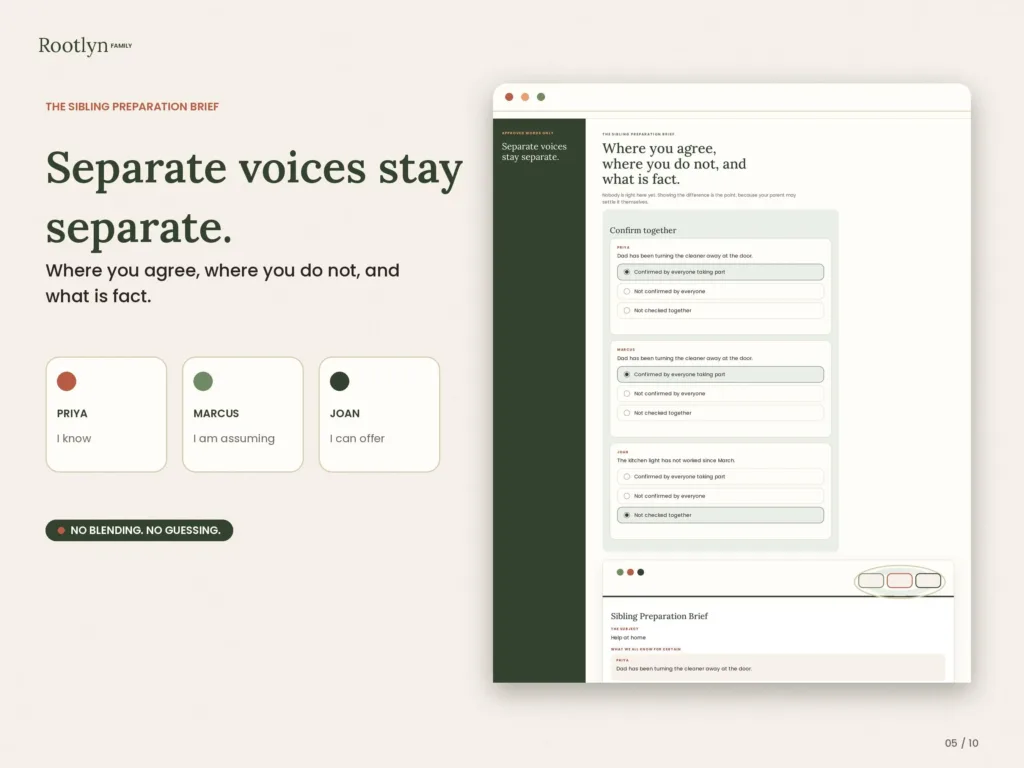
Within this process, each participant retains control over their entries. You can choose which answers to share with your brothers or sisters, which to keep completely private, and which to refine before sharing. This is not about concealing matters required for safe care; it provides a safe, reflective space to test your own thinking before presenting it to others.
The resulting Sibling Preparation Brief compiles everyone’s approved thoughts side by side. It highlights where siblings agree, reveals where observations diverge, and flags points that still need checking with your parent, without erasing anyone’s voice.
Discuss What Each Person Can Offer Without Assigning Roles
Family discussions often unravel when siblings start volunteering each other for tasks. One person assumes the sibling who works part-time can handle all doctor appointments, while another expects the sibling with higher earnings to pay for private domestic help.
Real stability comes from asking each brother or sister to state what they can offer freely, alongside clear boundaries about what they cannot take on. A realistic, limited offer made with certainty is far more helpful over time than a grand promise that leads to exhaustion or broken arrangements.
- Calling every Tuesday evening to catch up and check on the week ahead.
- Handling the online prescription reorders and pharmacy delivery dates.
- Providing transport to pre-booked hospital clinics once a month.
- Spending an hour on Saturday mornings taking the recycling out and checking light bulbs.
Clear, Sustainable Offers
- Assuming the nearest sibling will manage all unexpected daytime emergencies.
- Treating a one-off favour as an automatic, permanent weekly commitment.
- Agreeing to take over personal finances without discussing it with your parent first.
- Expecting a distant sibling to spend every annual leave allowance travelling back.
Common Assumptions to Avoid
Remember that a sibling’s offer is merely a possibility until two things happen: that sibling confirms their agreement, and your parent agrees they want that particular kind of help. If your mother prefers to handle her own banking or your father values walking to the chemist himself, imposing an unwanted service helps no one.
When you reach the stage of organising long-term schedules, practical guides on sharing ongoing care between siblings help structure day-to-day coordination without reigniting old family rivalries.
Prepare to Ask Your Parent One Thing
The most important principle in preparing to talk to an ageing parent is keeping their voice at the centre. Preparing as siblings must never turn into an ambush or a private committee that decides an older adult’s future behind closed doors.
There is a fundamental difference between presenting a finished plan and opening an honest conversation:
Imposing a decision: “We held a family meeting and agreed that you need someone to come in twice a week to clean and cook.”
Opening an enquiry: “We have noticed a few things feel heavier around the house lately, and we would like to understand what matters most to you right now.”
When you are ready to speak together, keep the focus narrow. Trying to resolve housing, driving, domestic help, and medical appointments in a single afternoon is overwhelming for everyone. Focus on one specific topic, and give your parent plenty of time to consider their response.
These three natural phrases can help guide each stage of communication:
- To invite a sibling to compare notes: “I’ve noticed a couple of practical changes during my visits lately; could we take half an hour to compare what we’ve both seen before we mention anything to Mum?”
- To acknowledge a difference without arguing: “I see this differently based on my calls with Dad, but I hear why you’re worried about his walking, so let’s write that down as something to ask him.”
- To ask your parent’s permission to talk: “There are a few domestic chores that seem to take up a lot of your energy; would it be all right if we chatted about whether you’d like a hand with any of them?”
Advice from Age UK on talking with older relatives stresses that listening without rushing to fix things is essential. An older person may have valid reasons for how they manage their day, and respecting their choices builds trust.
Practical approaches for raising the subject of help with an ageing parent emphasise having small, relaxed conversations over a cup of tea rather than convening formal summits. If a wider family discussion eventually becomes necessary, you can follow structured methods for preparing a wider family-meeting agenda while keeping the parent’s dignity firmly intact.
Make the Offline Workflow Concrete
Coordinating sensitive reflections among family members requires discretion and simplicity. The Parent Conversation is designed to work privately on your home computer without requiring logins, user accounts, or cloud storage.

Working through personal reflections offline gives each sibling space to consider their thoughts without external pressure.
The workflow follows five straightforward steps:
- Download and open locally: You receive a self-contained offline browser tool that runs directly in current versions of Chrome, Edge, or Firefox on Windows 11. It works completely offline after the initial download, keeping your family thoughts on your own device.
- Follow the Start Here guide: Read through the companion guidance pack (provided in both standard UK A4 and US Letter printables) to understand how the six reflection prompts work.
- Answer privately: Each sibling works through their six reflection questions at their own pace, exploring what they know, what they assume, what worries them, and what they can realistically offer.
- Approve what to share: Participants choose which individual answers to include in the shared document and which to keep private or rewrite, using simple local invitation codes or file exchanges.
- Review the combined brief: The tool compiles approved answers into a single Sibling Preparation Brief, clearly showing points of consensus, differences of opinion, and questions that must be asked directly of your parent.
An optional passphrase-protected family file allows siblings to save their progress and resume preparation by mutual agreement. After talking with your parent, the tool can also record what was actually said, what assistance was welcomed or declined, and what single item to find out before speaking again.
When Sibling Preparation Is Not Enough
A family preparation tool helps brothers and sisters organise their thoughts, but it is not a substitute for clinical insight, social services, or legal authority. Clarifying these boundaries protects both your parent and your family relationships.
The Parent Conversation does not assess mental capacity, diagnose medical conditions, evaluate driving competence, or calculate care fees. It organises what family members enter; it does not determine who is legally or medically right.
If you or your siblings notice sudden confusion, severe self-neglect, or an immediate risk of physical harm, you should not wait to complete a family exercise. Urgent health worries require medical attention via your parent’s GP or the NHS 111 service.
When ongoing practical support is required beyond what the family can manage, exploring an official assessment is the sensible route. Guidance from the NHS on getting a care needs assessment sets out how adult social services in England evaluate day-to-day requirements such as washing, dressing, and home safety (arrangements differ slightly in Scotland, Wales, and Northern Ireland). Professional social care teams and occupational therapists provide independent assessments that help families make informed choices together.
Frequently Asked Questions
What if we remember the same situation differently?
Differing memories are normal because each person experiences events through their own emotional perspective. Rather than debating who remembers correctly, note down both recollections as different views and agree to ask your parent for their perspective.
Can siblings prepare from different homes?
Yes, siblings can prepare independently from separate households. Each person completes their answers in their own offline browser tool, shares only what they choose using text codes or email exchanges, and merges their approved notes into the combined brief.
What if our parent does not want the conversation?
If your parent is not ready to discuss support, their decision should be respected unless there is immediate danger. “Not ready today” is a completely legitimate outcome, and giving them time often allows trust to develop naturally for a smaller chat later.
Does the tool assess care needs or decide who is right?
No, the tool does not evaluate care needs, measure safety, or pass judgment on sibling disputes. It simply organises what participants write down and redirects clinical or safeguarding uncertainties toward qualified professionals.
Does it work offline and include A4 printables?
Yes, the software runs locally in current browsers on Windows 11 without requiring internet access or account registration once downloaded. It includes a comprehensive five-page printable companion pack supplied in both UK A4 and US Letter formats.
Taking the First Small Step Together
Disagreements between siblings do not have to derail thoughtful support for an ageing parent. Taking time to separate observations from assumptions, identify clear personal limits, and prepare one respectful question keeps your parent in charge of their own decisions while helping brothers and sisters move forward in calm alignment.
To prepare separately and bring your approved answers into one brief, get The Parent Conversation on Etsy.
Last reviewed: