
To understand how to help a grieving friend after the funeral, pick one specific task you can reliably manage, check whether it is welcome, make declining effortless, and carry out whatever is agreed. Thoughtful assistance focuses on easing mundane friction rather than attempting to resolve deep pain, offering steady practical support for important relationships during a quiet stretch of bereavement.
What works best depends on your friend’s current daily demands and the honest limits of your own diary. Grounding your offer in what you can truly deliver prevents accidental disappointment and protects your friend from having to organise your good intentions.
Prepare an offer you can keep
Rootlyn’s private offline tool helps you choose two realistic options and prepare one message.

Why practical help after the funeral matters
The day of the funeral brings family, neighbours and colleagues together, but the weeks that follow often bring a sudden return to ordinary routines. The gathering concludes, the formal arrangements end, and the bereaved person is left navigating silent rooms, administration and daily chores. Grief does not operate on a formal timetable, and ordinary physical needs continue alongside emotional exhaustion.
Guidance from Marie Curie highlights that continuing to check in after the funeral can provide steady comfort when a person may feel especially isolated. The initial wave of visitors naturally recedes as people return to work and family commitments. Reaching out during this quieter phase shows that your care did not end when the service concluded.
There is a vital distinction between providing genuine assistance and asking someone to coordinate your help. Broad questions like “Let me know what you need” place the administrative burden directly back on someone whose cognitive energy is already depleted. Useful support suggests specific, defined actions that require only a simple yes, a preference, or a comfortable decline.
Sending condolences addresses the loss itself, but offering practical help addresses daily living. If you are still working out basic phrases of sympathy, reviewing advice on finding words after someone has died can help you keep messages of condolence separate from logistical offers.
Everyday British responsibilities, such as putting bins out, collecting groceries from the local supermarket, or walking a dog in wet weather, do not pause for sadness. Offering to absorb one small, concrete piece of that domestic workload gives practical relief without demanding emotional performance.
Scenario 1: When your friend mentions a practical errand
Hypothetical example: Your friend offhandedly mentions that their kitchen cupboards are bare and they have an online parcel return waiting by the front door. You have exactly one hour free on Thursday afternoon before you need to collect your own children.
Hypothetical Sample Message: The Errand
“Hi Sarah, I am running errands in town this Thursday between 2:00 and 3:00. I can either drop off that parcel return at the post office for you, or pick up bread, milk and fruit from the shop and leave them on your doorstep. If either helps, let me know by 1:00 on Thursday; if you are completely sorted, no need to reply at all.”

Focusing on standard household items allows practical support to fit naturally into existing errands.
This approach works because it attaches itself to specific tasks your friend has already brought up in conversation. You are not guessing what they need or inventing projects that create extra commotion in their home. The proposal remains firmly grounded in reality.
Stating a defined time window prevents open-ended waiting. Your friend knows exactly when you are available, and the deadline of 1:00 gives them a clear boundary so they do not feel guilty about an unanswered message later in the evening.
Crucially, an offer is not an authorisation to act independently. You must not collect private packages, handle financial purchases, or arrive at their home without unambiguous agreement. Anything touching personal property, finances, or family space requires active consent, and silence must never be treated as permission.
Start with what your actual week allows
Sustainable support begins by taking an honest look at your existing commitments before reaching out to someone in distress. Promising unlimited availability, such as saying you are free whenever they need you, often results in rushed visits, missed calls, or sudden cancellations. A small, modest favour that happens dependably is infinitely more comforting than an ambitious promise that falls through.
Consider your real constraints without guilt. Think about how far you can travel, how much fuel or public transport you can afford, and how much emotional patience you have after a difficult working day. Having realistic limits is completely normal, and respecting them allows you to be a calm presence rather than an overwhelmed helper.
Advice from Cruse Bereavement Support emphasises making specific, practical suggestions tailored to the individual’s situation rather than vague declarations. When you know precisely what you can deliver, your offers become concrete, easy to evaluate, and far less stressful for the recipient to receive.
Being honest about your personal capacity protects both people. Practising wording a realistic limit enables you to state your availability cleanly without awkwardness, resentment, or accidental overcommitment.
In Rootlyn’s Useful Offer Builder, this principle is built directly into the opening capacity questions. The tool asks about travel limits, cooking habits, and financial constraints, and provides a private “must not promise” field. That field never appears in your final note, but it firmly prevents the software from generating ideas that exceed your real energy.
Scenario 2: Offering low-pressure company without ongoing commitment
Hypothetical example: You want to offer human warmth and companionship, but your current workload and family life mean you cannot commit to a standing weekly dinner or open-ended weekend plans. You have forty-five minutes available on Saturday morning.
Hypothetical Sample Message: Low-Pressure Presence
“Hi David, I have about forty minutes free this Saturday around 10:30 am. I would love to bring round a takeaway tea for a quick garden sit, or we could take a quiet ten-minute turn around the park. Absolutely no pressure to talk about anything heavy or play host, and please feel free to say no if you would prefer quiet time.”
Accepting company should never feel like a performance for the bereaved person. They should not feel obligated to tidy the living room, brew fresh tea, disguise their sorrow, or maintain polite conversation. By framing the visit around a takeaway drink or an outdoor stroll, you remove host duties entirely.
The invitation also clearly sets the expectation around conversation. Your friend is free to talk about their loss, discuss completely mundane sports scores, or sit in silence without worrying about entertaining you. They know in advance that you are comfortable with whatever mood they bring to the table.
Notice that the message explicitly avoids misleading phrases like “I am always here for you.” While well-intended, claiming infinite availability can lead to feeling let down when you inevitably cannot answer the phone. Stating a realistic window builds honest, dependable trust.
How the Useful Offer Builder structures support
Creating a balanced, considerate proposal can feel challenging when you are worried about saying the wrong thing. Rootlyn designed the Useful Offer Builder to guide helpers through a private, structured method that eliminates guesswork. The entire process runs offline on your personal computer, keeping every thought, constraint, and contact detail entirely private.
- Enter your actual capacity, including your travel limits, budget, domestic skills, and private boundaries.
- Select the person’s current difficult season and your specific relationship to them.
- Browse a filtered library of practical offers matched strictly to what you can realistically deliver.
- Select two distinct options so your friend has agency without experiencing decision fatigue.
- Review the assembled message alongside explicit consent checks for private space, time, or finances.
- Save the generated commitment card so you have an exact personal record of what you agreed to do.
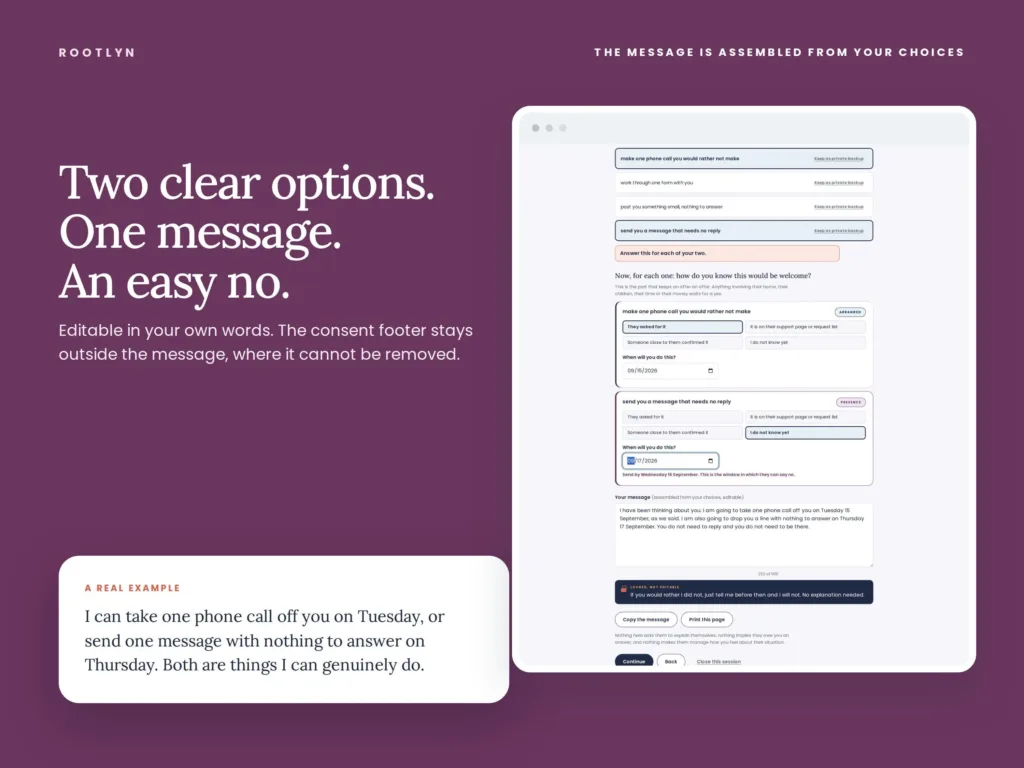
The system works entirely from your specific inputs. It does not attempt to guess what your friend needs or claim to know their feelings, but rather arranges your genuine willingness into a thoughtful note. Learning the underlying craft of making an offer without adding pressure ensures your friend feels respected rather than managed.
Because the tool operates locally without user accounts or server storage, you can download the package, extract the files, and open the tool directly in your web browser. Printable reference guides in both A4 and US Letter sizes are included for easy offline notes.
Scenario 3: When your message receives no reply
Hypothetical example: You sent a thoughtful note offering two practical favours four days ago, and your friend has not responded. You wonder whether they missed the text, felt offended, or need a gentle reminder.
Hypothetical Sample Message: The No-Reply Follow-Up
“Hi Emma, just sending warm thoughts your way today. No need to reply to this or my earlier note at all; just wanted you to know I am thinking of you and wishing you a gentle afternoon.”
Silence is never consent, but neither is it evidence of failure. During intense bereavement, reading a message, forming a sentence, and pressing send can feel like an insurmountable mountain. An unanswered text simply means your friend does not have the emotional reserve to engage right now.
Insights from Hospice UK highlight the importance of balancing steady long-term support with respecting a grieving person’s need for space. Following up with an unprompted repetition of your offer can inadvertently create pressure, turning your kindness into an uncompleted task on their mental checklist.
The Useful Offer Builder uses three practical rules for handling unanswered contact: honour any commitment already agreed, send a warm zero-demand message if appropriate, or step back and leave quiet space until they get in touch. Pushing for confirmation only transfers your anxiety onto their shoulders.
Keeping your promise without burdening your friend
The true value of any practical offer lies entirely in its dependable execution. When a grieving friend accepts help, they are placing a fragile piece of trust in your hands during a period of vulnerability. Arriving when you said you would arrive, purchasing the exact items requested, and completing tasks without requiring guidance makes your help a genuine relief.

Keeping your own notes and schedules allows you to carry out promises quietly without placing organizational burdens back on your friend.
If an unexpected emergency forces you to alter your plans, communicate the change promptly, plainly, and without demanding comfort from the bereaved person. State the facts, offer an alternative if possible, and take full ownership of the schedule adjustment. Avoid prolonged apologies that require them to reassure you that everything is fine.
Never rely on a grieving person to remind you of your own commitments. Use a personal notebook, a phone calendar, or the commitment card from the Useful Offer Builder to record dates, shopping lists, and specific arrangements privately.
Remember that waiting, offering a very small gesture, or deciding not to offer a task today are all sensible, legitimate choices. If you lack the emotional resilience or time to carry out a job properly, stepping back is far kinder than making a half-hearted promise you might fail to keep.
Frequently asked questions
Is it too late to offer help after the funeral?
It is rarely too late, as practical and emotional difficulties often continue for months or years after formal services end. Reaching out weeks or months down the line often feels especially meaningful because other social contact has naturally tapered off.
What if I have little time or money?
Valuable help does not require large financial outlays or whole free afternoons. Small, free gestures such as taking a wheelie bin out, returning a library book, or sending a caring message asking for no reply offer genuine relief without straining your budget.
Should I go ahead if my friend has not replied?
No, you should never undertake errands, make purchases, or visit someone’s property without their clear, active agreement. A lack of response means you should hold back, giving them space while remaining receptive whenever they feel ready to engage.
Does the tool work offline and send the message for me?
The Useful Offer Builder runs entirely offline on your personal computer and does not send messages automatically. You review, copy, and edit the final text yourself, sending it through your normal phone or messaging app when you are satisfied with it.
Supporting a friend on your own terms
Caring for a bereaved friend after the funeral does not require heroic measures or grand declarations. Choosing one small, manageable contribution, confirming it with gentle boundaries, and carrying it out reliably offers deep, steady comfort as normal life resumes.
To turn what you can genuinely offer into a clear message, get the Useful Offer Builder on Etsy.
Last reviewed: